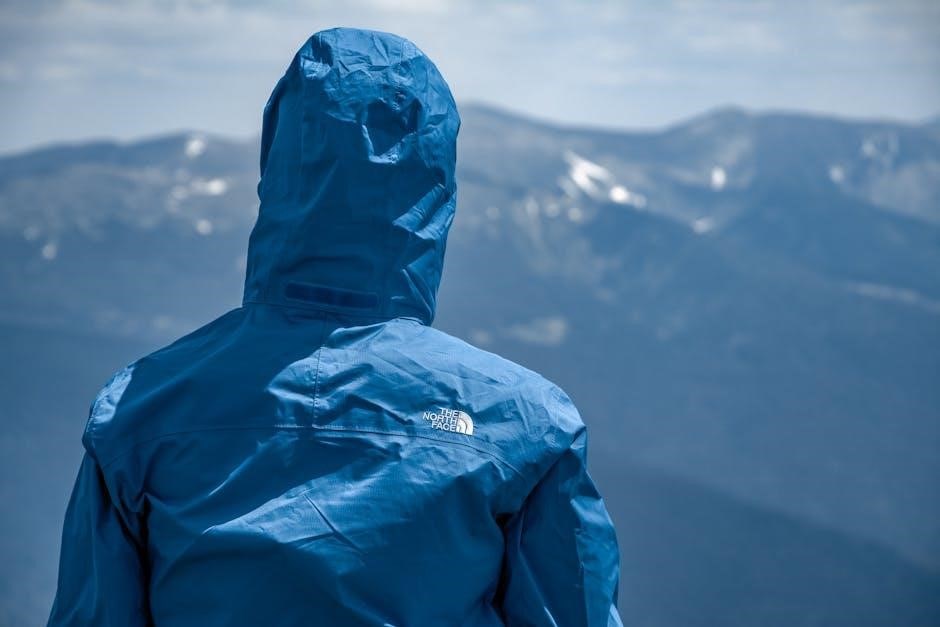
The North Face jackets boast innovative construction and waterproofing, requiring careful sizing consideration. From base to shell layers, understanding the fit—relaxed or standard—is crucial for optimal comfort and warmth during autumn and winter seasons.
Understanding The North Face Fit

The North Face employs various fits across its jacket range, impacting both comfort and performance. A key distinction lies in the “relaxed fit,” characterized by breathability while maintaining a close-to-body silhouette for heat retention. This isn’t a loose fit, but allows for comfortable movement and layering without excessive bulk.
However, not all North Face jackets adhere to this relaxed style. Some are designed with a more standard or athletic fit, offering a closer, streamlined profile. Understanding which fit a specific jacket utilizes is paramount to selecting the correct size. Consider your intended use; if you plan on extensive layering, a relaxed fit or sizing up is advisable. Conversely, if you prefer a snug, performance-oriented feel, a standard fit might be preferable. Always consult the specific product description for details on the jacket’s intended fit.
Why Accurate Sizing Matters
Accurate sizing is paramount when purchasing a North Face jacket, extending beyond mere aesthetics. A properly fitted jacket maximizes warmth by trapping body heat effectively, crucial in colder climates. Too small, and it restricts movement and compromises insulation; too large, and heat escapes, diminishing its protective capabilities.
Furthermore, the advanced waterproofing technology in North Face jackets relies on a snug, yet comfortable, fit to prevent water from entering through gaps. Incorrect sizing can compromise this vital feature. Considering layering is also key – if you intend to wear sweaters or hoodies underneath, accounting for that extra bulk is essential. Investing time in accurate measurements and referencing the official size charts ensures optimal performance and longevity from your jacket.

Men’s North Face Jacket Size Guide
For men, accurate chest, hip, and arm length measurements are vital for finding the perfect North Face jacket fit, ranging from sizes S to 3XL.
Chest Measurement & Size
Determining your chest size is the foundational step in selecting the correct North Face jacket. Use a flexible tape measure to measure around the fullest part of your chest, keeping the tape level and comfortably snug – not tight.
Refer to the official North Face size chart for men: a chest measurement of 36-38 inches typically corresponds to size Small (S), 39-41 inches to Medium (M), 42-44 inches to Large (L), 45-48 inches to Extra Large (XL), 49-52 inches to 2XL, and 53-56 inches to 3XL.
However, remember these are general guidelines. If your measurement falls between sizes, consider your build and desired fit. For a more relaxed fit, especially if layering, opting for the larger size is often recommended. Always prioritize comfort and freedom of movement when choosing your jacket size.
Hip Measurement & Size
Accurately measuring your hips is vital for ensuring a comfortable and well-fitting North Face jacket, particularly for styles with a more tailored cut. Use a flexible tape measure and measure around the fullest part of your hips, maintaining a level position and ensuring the tape isn’t overly tight.
According to The North Face size guide for men, hip measurements of 35-37 inches generally align with size Small (S), 38-40 inches with Medium (M), 41-43 inches with Large (L), 44-46 inches with Extra Large (XL), 47-49 inches with 2XL, and 50-52 inches with 3XL.
For larger sizes, 2X corresponds to 50.5-52.5 inches, 3X to 54.5-56.5 inches. If your hip measurement is close to the upper limit of a size, consider sizing up for greater comfort and mobility, especially when wearing layers underneath.
Arm Length Measurement & Size
Determining your correct arm length is crucial for a North Face jacket that allows for a full range of motion without feeling restrictive. To measure, extend your arm naturally and measure from the center back of your neck, over your shoulder, and down to your wrist bone.
The North Face men’s size chart indicates that a 33.5-inch arm length typically corresponds to size Small (S), 34.0 inches to Medium (M), 34.8 inches to Large (L), 35.5 inches to Extra Large (XL), 36.3 inches to 2XL, and 37.0 inches to 3XL.
For extended sizes, 2X jackets feature a 35-36 inch arm length, while 3X jackets have a 35.75-36.75 inch arm length. If your measurement falls between sizes, consider your build and layering preferences; opting for the larger size may provide a more comfortable fit.
Specific Men’s Sizes (S, M, L, XL, 2XL, 3XL)

The North Face offers a comprehensive range of men’s sizes to ensure a proper fit. Size Small (S) generally fits chests measuring 36-38 inches and hips of 35-37 inches. Medium (M) accommodates 39-41 inch chests and 38-40 inch hips. For a 42-44 inch chest and 41-43 inch hips, Large (L) is recommended.
Extra Large (XL) suits chests of 45-48 inches and hips of 44-46 inches. Moving to larger sizes, 2XL fits chests of 49-52 inches and hips of 47-49 inches, while 3XL is designed for 53-56 inch chests and 50-52 inch hips. Remember these are guidelines; individual builds may vary.
Always consult the official North Face size chart for the most accurate measurements and consider layering when selecting your size.
Women’s North Face Jacket Size Guide
The North Face women’s sizing requires bust, waist, and sleeve measurements for an accurate fit, ensuring comfort and warmth with various jacket styles and layering options.
Bust Measurement & Size
Determining your bust measurement is the first step in finding the perfect North Face jacket fit. Use a flexible measuring tape and measure around the fullest part of your bust, keeping the tape level and comfortably snug – do not pull it too tight.
Compare your bust measurement to The North Face’s official size chart. Generally, sizes correlate as follows: for a bust of 35-37 inches, a size Small is recommended; 38-40 inches corresponds to a Medium; 41-43 inches to a Large; 44-46 inches to an Extra Large; and 47-49 inches to a 2XL.
However, remember that these are general guidelines. If your measurement falls between sizes, it’s often advisable to size up, especially if you plan on layering clothing underneath your jacket. Consider the jacket’s intended use and fit – a relaxed fit might require a different size than a more fitted style. Always prioritize comfort and freedom of movement.
Waist Measurement & Size
Accurately measuring your waist is crucial for a comfortable and flattering fit in a North Face jacket. Find your natural waistline – typically the narrowest part of your torso, located above your belly button. Use a flexible measuring tape, ensuring it’s level and snug, but not constricting.
Refer to The North Face size guide to correlate your waist measurement with their sizes. A waist measurement of 27-29 inches generally corresponds to a size Small, while 30-32 inches suggests a Medium. For 33-35 inches, a Large is usually appropriate, 36-38 inches a size XL, and 39-41 inches a 2XL.
If your waist measurement is close to the upper limit of a size, or if you plan to wear layers, consider sizing up for a more relaxed and comfortable fit. Remember that jacket styles vary, and some are designed with a more tailored waist than others.
Sleeve Length Measurement & Size
Determining the correct sleeve length ensures both comfort and functionality in your North Face jacket. To measure, extend your arm naturally and have someone measure from the center back of your neck, over your shoulder, and down to your wrist bone. Keep your elbow slightly bent during measurement.
Consult The North Face size chart to match your sleeve length to the appropriate size. Generally, a sleeve length of around 33-34 inches aligns with a size Medium, while 34.5-35.5 inches suggests a Large. For those needing 36-37 inches, an XL is typically suitable.
If your measurement falls between sizes, consider your layering preferences. If you frequently wear bulky sweaters, opt for the larger size to avoid restricted movement. A slightly longer sleeve is preferable to one that’s too short, hindering comfort and potentially impacting performance.

Layering and Sizing Considerations
When layering under your North Face jacket, especially in colder climates, sizing up is recommended to accommodate extra bulk from hoodies or sweatshirts for comfort.
Sizing Up for Layering
Considering layering is paramount when selecting the correct North Face jacket size, particularly if you anticipate wearing additional garments underneath. The brand’s relaxed fit offers some flexibility, but for substantial layering – think thick hoodies, fleece pullovers, or even multiple thermal layers – opting for a size larger than your typical fit is highly advisable.
This ensures unrestricted movement and prevents the jacket from feeling constricting when fully layered. A snug fit might be comfortable on its own, but it can become incredibly uncomfortable when combined with bulky underlayers. If you frequently find yourself in very cold conditions, proactively sizing up will provide the necessary room for optimal warmth and comfort. Remember to consider the thickness and number of layers you intend to wear regularly.
Ultimately, prioritizing comfort and freedom of movement when layering will enhance your overall experience with your North Face jacket.
Understanding “Relaxed Fit”
The North Face frequently employs a “relaxed fit” in many of its jacket designs. This doesn’t equate to oversized; instead, it signifies a cut that prioritizes breathability and comfortable movement while still effectively retaining heat; A relaxed fit allows for a wider range of motion and accommodates light layering without feeling overly tight or restrictive.
However, it’s crucial to understand that “relaxed” doesn’t mean you should automatically downsize. The design is intentionally more forgiving, providing space without sacrificing warmth. If you prefer a closer, more streamlined silhouette, you might consider your usual size, but be mindful of potential limitations with heavier layering.
For those who prefer a roomier feel or plan on substantial layering, sticking with your measured size or even sizing up slightly is recommended to fully benefit from the relaxed fit’s comfort and functionality.

North Face Jacket Styles & Fit Variations
The North Face offers diverse jacket styles—puffer and shell—each with unique fits impacting sizing. Consider the specific style when selecting your ideal size for optimal performance.
Puffer Jacket Sizing
Puffer jackets from The North Face are renowned for their warmth and insulation, often featuring a “relaxed fit” designed to be breathable while retaining heat. However, this relaxed fit presents unique sizing considerations, particularly if you intend to layer clothing underneath.
If you live in a colder climate or plan to wear a hoodie or sweatshirt beneath your puffer jacket, it’s highly recommended to size up from your usual size. This ensures sufficient room for layering without compromising comfort or restricting movement. A snug fit can negate the insulating benefits of the puffer, while too much room can reduce warmth.
Refer to The North Face’s official size chart, paying close attention to chest and hip measurements. Remember that puffer jackets are designed to have some volume, so don’t expect a super-slim fit even when sized correctly. Prioritize comfort and the ability to layer effectively when choosing your puffer jacket size.

Shell Jacket Sizing
Shell jackets from The North Face are designed to be versatile, providing protection from the elements while allowing for layering to adapt to varying conditions. Unlike puffer jackets, sizing for shell jackets often prioritizes a more adaptable fit, allowing room for multiple layers underneath without feeling bulky.
When selecting a shell jacket size, consider the types of layers you typically wear. If you plan on wearing thick fleece or insulated jackets underneath, sizing up is advisable. However, if you primarily intend to layer with lighter base layers and a mid-layer, your regular size may suffice.
Pay attention to arm length and chest measurements on The North Face’s size chart, ensuring adequate range of motion. A well-fitted shell jacket should allow for comfortable layering without restricting movement during activities. Remember to account for the added volume of layers when assessing the overall fit.

Where to Find Official North Face Size Charts
Official size charts are readily available on The North Face website and at authorized retailers, ensuring accurate measurements for the perfect jacket fit.
The North Face Website Size Guide
The North Face website provides a comprehensive and user-friendly size guide, designed to help customers find their ideal fit. This guide typically includes detailed charts for both men’s and women’s jackets, covering key measurements like chest, hips, waist, and sleeve length.
Navigating the guide is straightforward; simply select your gender and the specific jacket style you’re interested in. The website then presents a chart with corresponding sizes based on your measurements. It’s recommended to take accurate measurements using a flexible tape measure, ideally with the assistance of another person.
Beyond the charts, The North Face website often includes helpful tips on how to measure correctly and understand different fit types, such as relaxed or standard. They also provide guidance on sizing up for layering, ensuring you have enough room for comfortable movement and warmth. Regularly checking the official website is crucial, as size charts can be updated periodically.
Retailer Specific Size Charts
When purchasing The North Face jackets from retailers other than the official website, it’s vital to consult their specific size charts. While The North Face maintains consistent sizing standards, variations can occur due to retailer-specific interpretations or manufacturing differences.
Many retailers will display a size chart directly on the product page, allowing for a quick and convenient comparison of your measurements. However, it’s always prudent to double-check these charts against the official North Face guide, especially if you’re unsure about your size.
Pay close attention to any notes or disclaimers provided by the retailer regarding sizing. Some may indicate whether the jacket runs true to size, small, or large. Reading customer reviews can also offer valuable insights into the fit of a particular jacket at that retailer. Prioritizing these checks ensures a more accurate purchase.